2026 ESOO
By Leonardo Prasetyo published
The 2026 ESOO has just been released. Whatever view you take on AEMO’s forecasts, they will now find their way into a lot of market models. It will be interesting to see what changes as a result, and whether the price collapse many are speculating still holds.
Data centres have received plenty of press recently, and the debate is becoming increasingly politicised. As the issue is pulled further into party politics, there is a significant risk that decisions about how this load growth is assessed, managed and paid for will have unintended consequences across the wider energy market and our power bills at home.
For those following along, Texas has introduced firmer financial commitments for large loads, while Governor Abbott has been explicit that data centres should pay the infrastructure costs they create rather than shift them to households and small businesses.
Closer to home, NSW has announced a 75-day assessment pathway for data centres that meet its new guidelines. At the same time, it is consulting on entry bonds, payments for network capacity made available whether it is ultimately used or not, and major network upgrade fees.
The Federal Government is also moving towards legislated national standards that would require large data centres to underwrite their own power supply, pay their share of connection costs and reduce demand when the grid needs support.
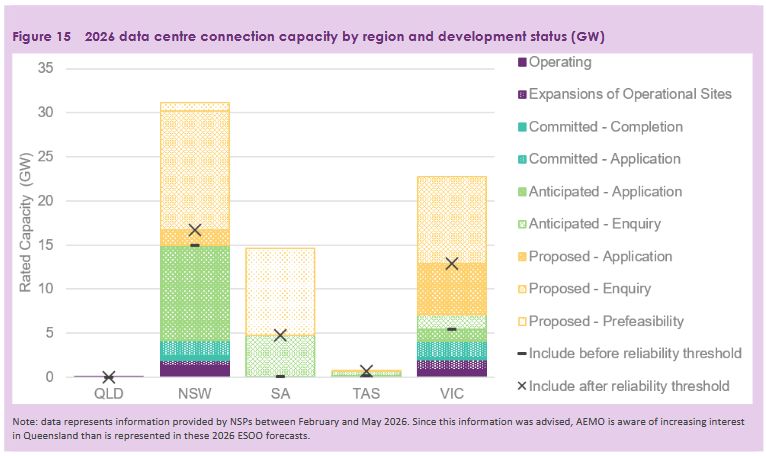
AEMO identified 225 known data-centre projects with 67 GW of proposed connection capacity, an increase of 76% from 38 GW last year. AEMO also reports that ~36% of the projects on its 2025 data-centre list have since been cancelled. More than ~30% of those cancelled projects had previously been classified as committed.
There is growing uncertainty about whether projects are real or speculative and what demand will materialise. Data for South Australia makes this particularly clear.
It has almost 15 GW of proposed data-centre connection capacity, compared with current maximum operational demand of around 3 GW. Almost all of that pipeline is still at an early stage.
Even a small proportion of that pipeline progressing would materially affect South Australia’s demand outlook. A model that assumes a significant share proceeds would produce a radically different outlook, with major implications for generation, network investment and system reliability.
So when you are reviewing your next forward curve; How much of that 67 GW is embedded in your demand assumptions?